Recommendation systems on social media platforms
The fifth wave of the survey examined the extent to which people—social media users—in the countries surveyed are aware of how AI-based recommendation systems work on social media and what they mean for users, given that these systems play a crucial role in determining what information is presented to platform users and in what order. Questions regarding recommendation systems were asked only of those who use social platforms or media at least occasionally and have therefore encountered AI-based recommendation systems.
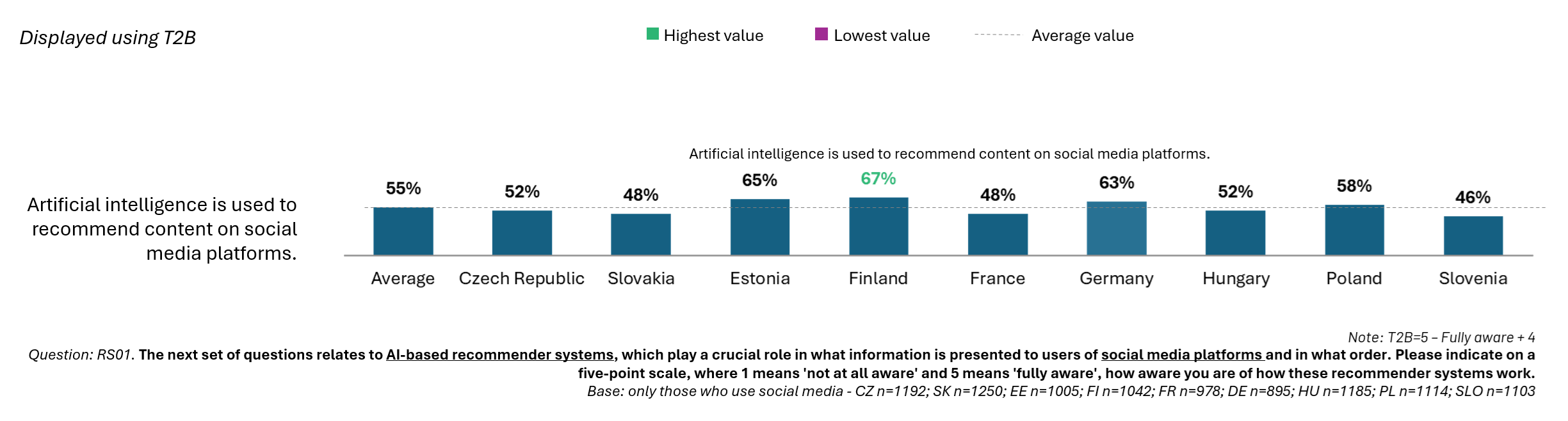
Awareness of the basic fact that artificial intelligence is used to recommend content on social media platforms is reported by 48% of social media users in Slovakia, 52% of social media users in the Czech Republic, 52% of users in Hungary, and 58% of users in Poland. This is most commonly recognized by Finns (67%), Estonians (65%), and Germans (63%). In contrast, the fewest people are aware of this in Slovenia, where not even half of social media users (46%) are aware of it.
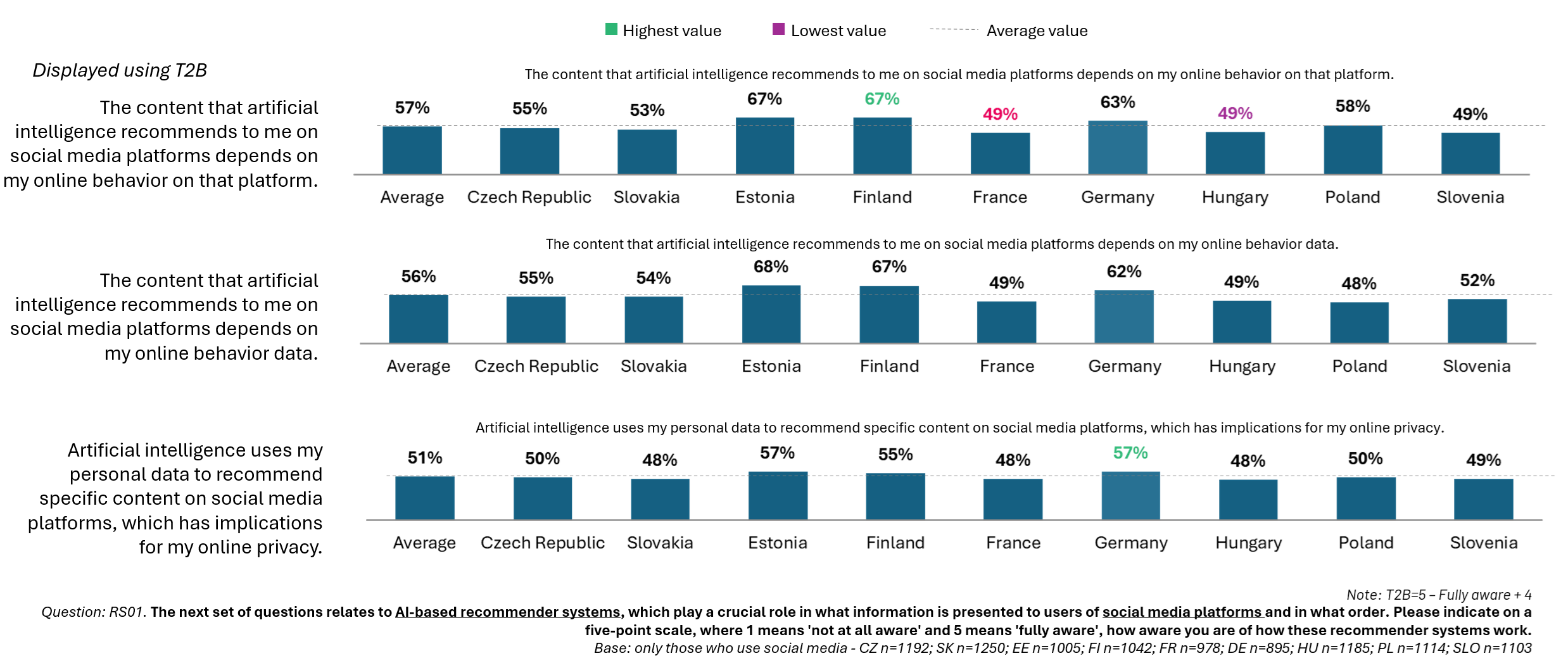
When it comes to recommendation systems and online behavior, Finns and Estonians. More than two-thirds of Estonians (67%) and Finns (67%) are aware that the content recommended by artificial intelligence on social media platforms depends on the user’s online behavior on that platform. Hungarians, French, and Slovenians are the least aware of this, at 49% each. The fact that the content recommended to users by artificial intelligence on social media platforms depends on all data on individual users’ online behavior is recognized by 68% of Estonians, 67% of Finns, and 62% of Germans. In contrast, only 48% of Poles, 49% of Hungarians, and 49% of French social media users are aware of this.
Germans and Estonians are the most cautious regarding the impact of recommendation systems on an individual’s online privacy. The fact that artificial intelligence uses personal data to recommend content on social media platforms, which has implications for users’ online privacy, is recognized by 57% of them. Users from Slovakia, Hungary, and France are the least aware of this, with 48% of them in each country.
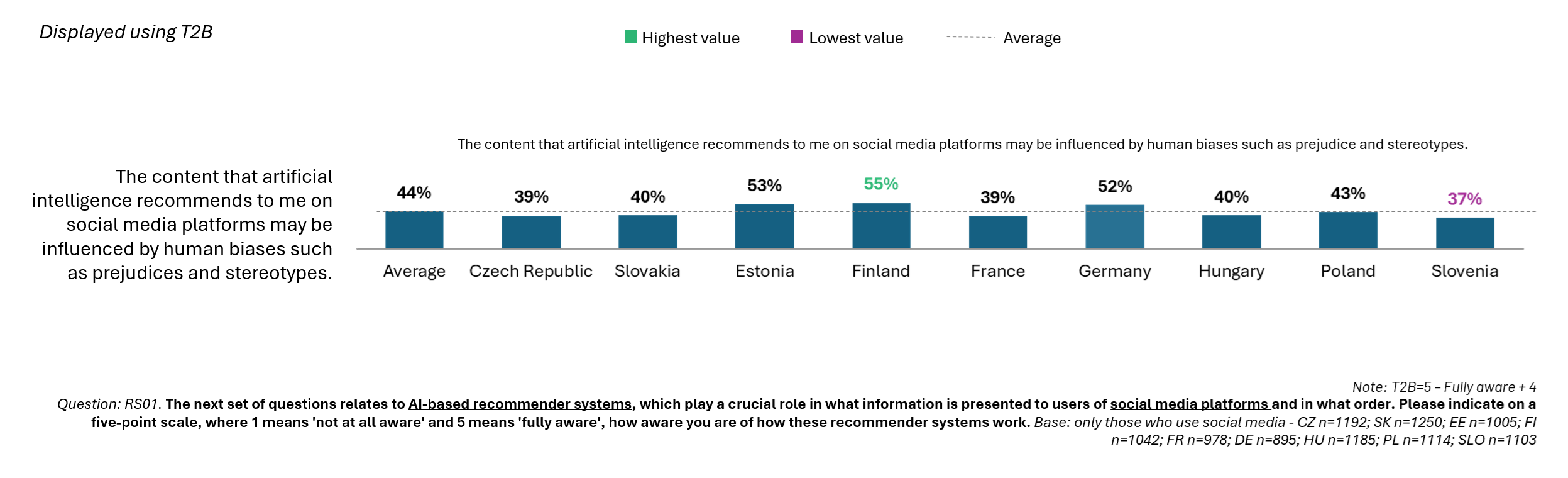
55% of Finns, 53% of Estonians, and 52% of Germans acknowledge that the content recommended to them by artificial intelligence on social media platforms may be influenced by human biases such as prejudices and stereotypes. Slovenians are the least aware of this, with just over a third (37%) acknowledging it. 39% of Czechs, 40% of Slovaks, and 40% of Hungarians who use social media platforms are aware of this.
According to the survey, social media users in Finland and Estonia are most aware of the risks that content on social media is tailored to them based on their online behavior and personal data and may also be influenced by human biases. Conversely, in countries such as Slovenia, France, and the Visegrád Four countries, including the Czech Republic, there is noticeably less awareness of these mechanisms, which points to varying levels of public debate regarding the impact of technology on society.
Attitudes and Opinions on AI-Powered Content Recommendations
Regarding attitudes toward recommendation systems, on average across the countries surveyed, nearly two-thirds of people fear that social media platforms do not adequately protect users’ privacy. The French are the most skeptical when it comes to artificial intelligence. Sixty-nine percent of social media users in France have privacy concerns. High levels of concern are also seen among Slovenians (66%), Slovaks (65%), and Finns (65%). The Czech Republic (64%) and Estonia (64%) are at the average level., we see slightly lower levels of concern among Germans (63%) and Hungarians (63%), while the lowest levels of concern are reported by social media users in Poland (56%).
Awareness of profiling and the use of personal data for advertising averages 52%. Awareness is highest among Slovenians (58%), Finns (56%), Germans (55%), and Hungarians (55%). Estonia (49%) and Poland (49%) are slightly below average. The lowest awareness of profiling and the use of personal data for advertising is found in the Czech Republic (46%). It is precisely Czechs, who have relatively high concerns about privacy, also show the lowest awareness of the specific mechanisms of user profiling.
Attitudes of the benefits of AI-powered content recommendations vary across countries. On average, 44% of respondents agree with the statement that AI helps find interesting content that users would not otherwise discover, with the highest agreement among Slovenians (51%) and Hungarians (50%). Conversely, Finns and Germans (both 39%) agree with this the least.
Hungarians (44%) and Slovenians (42% and 43%) also agree strongly with other aspects, such as satisfaction with social media platforms using artificial intelligence to display content tailored to users’ interests and online behavior, or the idea that automated content recommendations powered by artificial intelligence are a good way to keep track of what is happening in society, Hungarians (44%) and Slovenians (42% and 43%) agree the most, while Finland is cautious and agrees the least (33% and 30%). Czechs agree in both cases at 41%, Poles at an average of 38%, and in Slovakia, an average of 40% of users agree. Slovenia and Hungary are significantly more open to automated content recommendations than other countries, while Finns are among the most critical respondents across most of the indicators surveyed.
The data also reveals a discrepancy between the low rate of reading terms of service and, at the same time, relatively low trust in their ability to protect users. On average, 37% of respondents report that they read the terms of service and information about how automated content recommendations work in detail before joining social media, while 48% of respondents trust that these terms and regulations sufficiently protect users from the undesirable effects of artificial intelligence. In some countries, this discrepancy is even more pronounced. For example, in the Czech Republic, only 33% of respondents read the terms of service, but 48% express confidence in their protective function. Similarly, in Poland the figures are 37% versus 50%, and in Slovakia 33% versus 51%. In contrast, Germany shows not only low trust (40%) but also a relatively low willingness to read the terms (44%), suggesting a generally more skeptical attitude. The data thus show that while most users do not familiarize themselves with the terms and conditions in detail, they often expect a certain degree of protection from them. At the same time, however, , trust in these mechanisms is not particularly high, suggesting that when it comes to privacy and how algorithms work, users operate in an environment of uncertainty rather than informed decision-making.
Basic Parameters
Research title: CEDMO Tracking (V4+5)
Main data collection period: Wave 5, April 2, 2026 – April 21, 2026
Target group: representative population aged 15+
Method of respondent selection: quota sampling
Quota settings: based on data from statistical offices in each country
Quotas tracked: gender, age, education, region, size of place of residence
Data collection method: CAWI survey using an online panel
Total sample: Wave 5: n=11,556 (all countries): CZ n=1,391, SK n=1,391,
EE n=1,224, FI n=1,249, FR n=1,298, DE n=1,252, HU n=1,251, PL n=1,249, SL n=1,251
*Data collection for the CEDMO Tracking survey was funded by the National Recovery Plan as part of the project MPO 60273/24/21300/21000 CEDMO 2.0 NPO.