The European Union has only a few days left before the temporary exemption from the ePrivacy Directive (known as Chat Control 1.0) expires. Since 2021, this exemption has allowed online service providers to voluntarily detect child sexual abuse material. The provisional regulation is valid until Friday, April 3, 2026, after which it will expire without replacement. The European Commission’s proposal to extend its validity until August 2027 was rejected by the European Parliament in March. A permanent legal framework (known as Chat Control 2.0 – Child Sexual Abuse Regulation/CSAR), which was intended to replace the current temporary regulation, is under discussion. Here at Central European Digital Media Observatory (CEDMO), we investigated public perception of the controversial points of the planned regulation in a unique representative survey conducted in late January and early February 2026 in nine European countries (the Czech Republic, Slovakia, Poland, Hungary, Slovenia, Estonia, Finland, Germany, and France).
“The survey shows that the European public is divided on the issue of Chat Control 2.0: while the majority expects increased safety, a portion of the population expresses concerns about threats to freedom of speech or invasions of privacy. At the same time, people’s willingness to change their online behavior is growing—and one-fifth of them are even willing to protest the regulation in some way. The data reveal significant differences not only between individual countries but also among sociodemographic groups,” summarizes the key findings Ivan R. Cuker, a sociologist and data analyst at CEDMO at Charles University, who also outlines the political context: “Chat Control 2.0 has not only public opponents but also political ones. Four countries did not support the final compromise reached by member states in the EU Council: the Czech Republic, Italy, the Netherlands, and Poland. Critics point in particular to the risks of extensive surveillance, interference in private communications, and the potential impact on encryption.”
Awareness of Chat Control 2.0 is low, highest in Germany
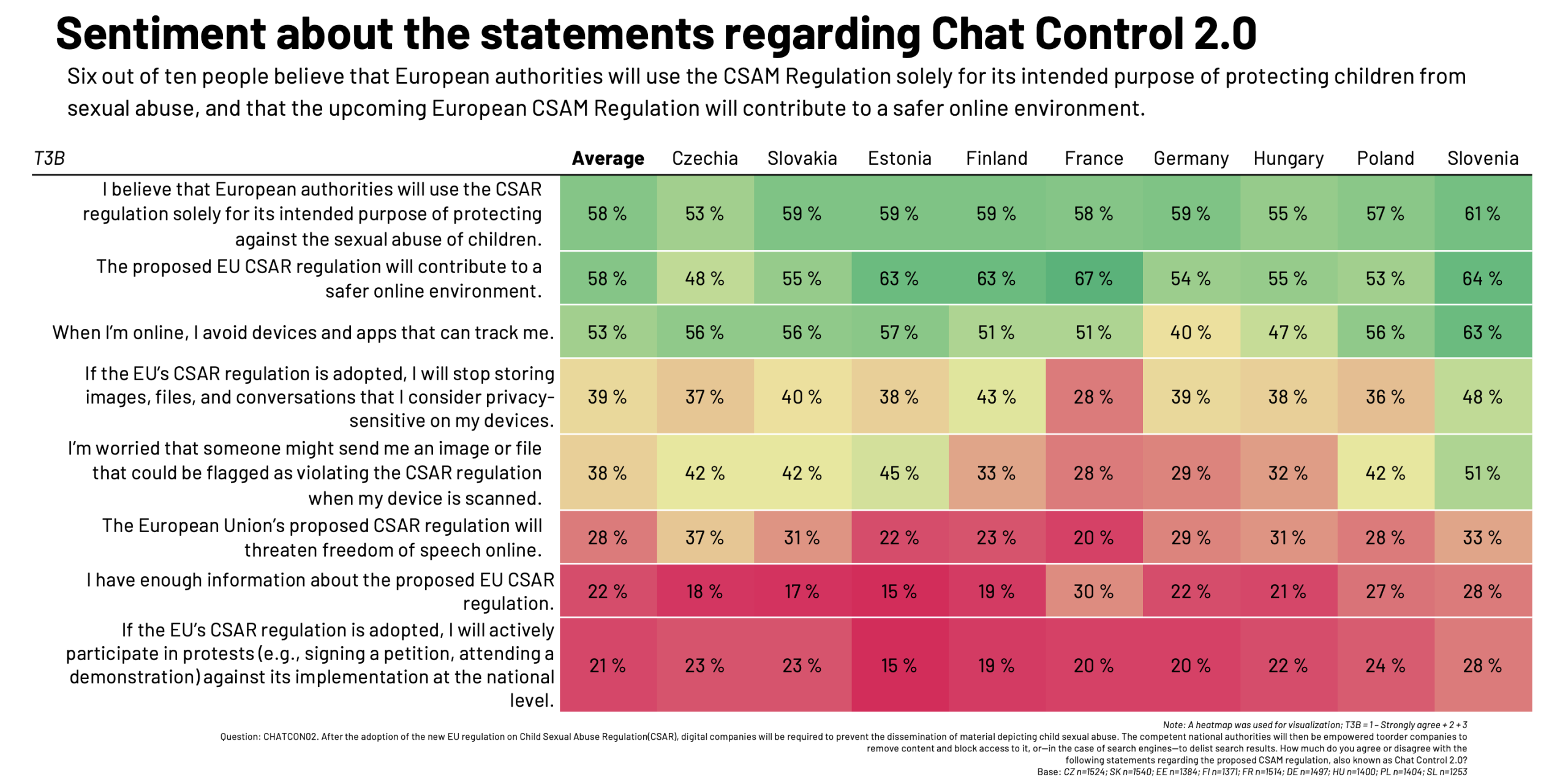
The upcoming regulation on preventing and combating child sexual abuse online (known as Chat Control 2.0) was recognized by an average of only 21.7% of respondents across the nine European countries surveyed. Awareness is highest in Germany and lowest in Estonia. Only 21.6% of people confirmed having sufficient information about the proposal, with the French being the most informed and the Estonians the least. Compared to the average of the nine countries (21.7%), awareness in the Czech Republic is slightly higher (26.3%), while in Slovakia it is significantly lower (18.5%). In Poland, awareness stands at 26.2%, similar to the Czech Republic and above the European average. When it comes to feeling sufficiently informed (average 21.6%), Czechs (17.6%) and Slovaks (16.8%) lag behind the average for all countries, while Poles slightly exceed it (26.7%).
Concerns about threats to freedom of speech: Czechs are the most skeptical
A total of 28.1% of respondents believe that Chat Control 2.0 could threaten freedom of speech in the online environment. The highest level of concern was recorded in the Czech Republic, and the lowest in France. Concerns about the potential for incorrect content labeling during scanning affect 38.1% of people, most frequently in Slovenia. While 28.1% of respondents on average across Europe fear a threat to freedom of speech, this figure is significantly higher in the Czech Republic (37.1%). Slovakia, at 31.3%, is slightly above average, and Poland, at 28.4%, is in line with the European level. Similarly, concerns about incorrect content labeling in these three countries remain above or around the average (38.1%): 41.6% in the Czech Republic, 42.2% in Slovakia, and 41.8% in Poland.
Most of the public believes that regulation will increase safety
Over half of those surveyed (57.6%) expect the proposal to lead to a safer online environment. This view is most strongly supported in France and least so in the Czech Republic. At the same time, 57.8% of respondents trust that European authorities will use any regulation exclusively to protect children. Compared to the European average (57.6%), fewer Czechs (47.6%) expect greater safety, while Slovakia (54.6%) and Poland (52.9%) are closer to the European average. Confidence that the EU will use regulation solely to protect children (average 57.8%) is lower in the Czech Republic (53.1%), while in Slovakia (59.1%) and Poland (57.3%), it roughly corresponds to the overall European picture.
Users’ willingness to change behavior
A potential change in behavior in connection with regulation is reflected in the fact that 38.4% of respondents would stop storing sensitive photos, files, or conversations on their devices once the regulation is adopted. Slovenians are most likely to consider this, while the French are least likely. A total of 52.8% of people already avoid apps and devices that can track users. The willingness to stop storing sensitive files after the regulation is adopted (average 38.4%) is reported by Czechs (37.3%) and Poles (35.5%) at a slightly lower rate than the average, while Slovaks (39.9%) slightly exceed it. Similar to the average across all countries (52.8%), residents of the Czech Republic (56.1%), Slovakia (55.7%), and Poland (56.1%) already largely avoid apps that can track their activities.
Over 20% of people are prepared to protest
And 21.3% of respondents would be willing to actively oppose the potential implementation of regulation in some way, with Slovenia showing the highest willingness to protest and Estonia the lowest. The willingness to protest in the Central European region corresponds to the European average (21.3%): 22.6% in the Czech Republic, 22.7% in Slovakia, and 23.5% in Poland. These figures are thus slightly above average for all three countries and confirm that the debate on CSAR may resonate more politically in the region than in some other European countries.
Young people: higher awareness, but lower trust and weaker protective behavior
The data show that young people are significantly more likely to be aware of the regulatory debates than the rest of the population. In the Czech Republic, 42.5% of respondents aged 15–24 were aware of developments surrounding CSAR, significantly higher than the overall average of 26.3%. At the same time, however, young people do not differ in their views on freedom of speech: 35.7% of young people express concerns about threats to freedom, nearly the same as the general population (37.1%). Young people are even less cautious in their perception of the risk of content being mislabeled—36.7% of them express concern, while among the oldest age group (66+), the figure is 47.7%. Similar differences are evident in terms of trust: while 53.1% of Czechs overall believe that the EU will use the regulation exclusively to protect children, only 48.1% of young people share this view, whereas seniors show higher levels of trust (63.6%). At the same time, the younger generation is less likely to take steps to protect their privacy—only 29.4% of young people would delete sensitive files after the regulation is adopted (compared to 48.9% of seniors), and 43.3% of young people take preventive measures against tracking apps, compared to 70.3% of the oldest generation. The potential for protest is slightly higher among young people: 24.6% of them would consider joining the resistance against the possible implementation of the CSAR.
Young people follow politics more closely, but protect their privacy less
The findings reveal several important trends for both platforms and policymakers. Young people have above-average awareness of ongoing debates, but their concerns about the impact on freedom of speech do not differ from the general population, and they perceive the risk of content being mislabeled as lower than the oldest generation. At the same time, young people express less trust in European institutions than older people, suggesting a need for greater transparency and clearer communication. The biggest difference, however, is evident in protective behavior: the younger generation takes significantly fewer precautions against surveillance, deletes sensitive files less frequently, and generally employs fewer preventive measures. Security and privacy-by-design strategies should therefore target young users specifically to reduce the existing privacy gap between generations.