Despite stricter European rules for digital platforms, data from the Central European Digital Media Observatory (CEDMO) show that users in the Czech Republic face frequent content and account removals, low success rates for appeals, and persistent lack of transparency regarding moderation. Protection exists on paper, but in practice, users still do not feel it. Over the past year, content was deleted for 8% of Czechs—of those who appealed (50%), only 14% were successful. More than a third of appeals (35%) were denied, and in 27% of cases, the outcome was unclear. In the past year, 2% of respondents experienced not just the removal of content, but the deletion of their entire account. At a time when the European Union is tightening rules for major online platforms, the reality for (not only) Czech users remains contradictory: platform interventions against them are often unclear, responses vague, but the impacts are palpable.
According to research conducted for CEDMO by the IPSOS research agency, in the majority of cases over the past year, content was removed directly by the platform itself (39%)—most frequently Facebook, Instagram, and TikTok. In 16% of cases, content was removed by another social media user acting as a moderator or administrator. In 45% of cases, users did not know who was responsible for removing the content. In the Czech Republic, 71% of people use social media daily, which demonstrates that the impact of these interventions is widespread, not marginal.
The Most Common Reason for Content Removal in the Czech Republic? – Politics.
The most common reason for content removal in the Czech Republic is politics (24%), followed by international conflicts and wars (8%). Content was deleted for satire, jokes, opinions, or sharing the truth in 5% of cases. In contrast, personal photos, for example, were the reason for content deletion in only 2% of cases in the Czech Republic (by comparison, in Poland, where the survey was also conducted, this was the most common reason for content deletion, accounting for one-fifth of users—20%).
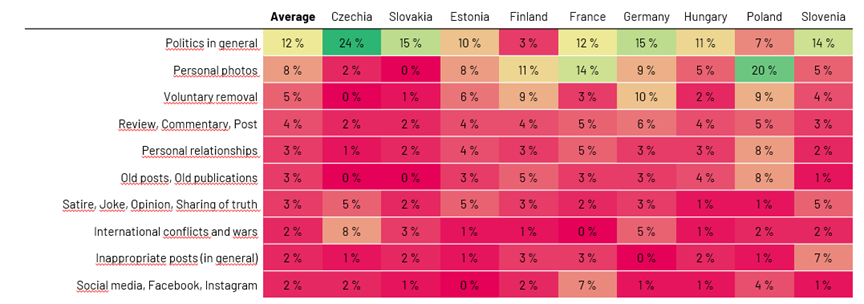
Chart: Topics of removed content in all nine monitored countries, CEDMO Tracking V4+5 – heatmap Survey question: “What topic(s) did the removed post concern?” – open-ended question, showing the ten most common responses Source: CEDMO Tracking V4+5, Client: Charles University, Data collection: IPSOS, Wave IV: Jan. 15 – Feb. 5, 2026, N = 1,524 respondents in the Czech Republic, N = 12,887 respondents in total across nine countries
The Impact of Social Media on Freedom of Speech – The Czech Republic Is Divided into Three Camps
According to CEDMO[2] , Czech users perceive social media as a significant factor in the public sphere: nearly half (49%) consider it a player with significant influence on political events, one-third (31%) attribute moderate influence to it, and one-fifth (20%) only minor or no influence. However, when assessing the impact on freedom of speech, Czechs are divided into three nearly equal camps—30% view it negatively, 35% positively, and an equal share (35%) take a neutral stance. This divergence shows that the role of social media remains highly polarizing.
Implementation of European Regulations to Protect Users in the Czech Republic is Lagging
“The main European regulations protecting social media users are the GDPR (General Data Protection Regulation), the DMA (Digital Markets Act), and the DSA (Digital Services Act). The GDPR addresses the protection of personal data; its impact on social media is evident, for example, in the regulation of personalized advertising. However, the limits of digital regulation are still being tested by social media practices. An example of this is the ‘pay or consent’ model, where users must choose between sharing their personal data for targeted advertising or paying for a subscription. This approach raises the question of whether such consent is truly voluntary,” explains Jana Vorlíček Soukupová, a CEDMO expert on digital technology law at Charles University, and continues: “Regulations such as the DSA and DMA are relatively new. In addition to rules concerning illegal content, the DSA also focuses on the transparency of recommendation systems (algorithms) and the mitigation of systemic risks. However, the Czech Republic has not yet adopted an implementing law, so it lacks a national supervisory authority—and the enforceability of the rules is thus limited in practice. A draft of the Digital Economy Act is currently before the Chamber of Deputies, where, on Tuesday, March 10, after months of delays, it passed its first reading and moved to the next stage of deliberation. Moreover, this is the second time it has been before the Chamber. The European Commission has already taken the Czech Republic to court for failing to fulfill its obligations regarding the implementation of the DSA.”
“On the other hand, when it comes to social media, the lack of implementation of the DSA at the national level is not necessarily a problem. Social media platforms like TikTok or Instagram are among the so-called very large online platforms (VLOPs), which are subject to oversight by the European Commission. In 2025, the Commission imposed a fine on Platform X, and investigations are currently underway regarding Meta and TikTok as well. The final outcome for those cases is still pending,” adds Jana Vorlíček Soukupová.
Awareness of European Regulation is Growing, but Information Remains Insufficient
“Awareness of the European Digital Services Act (DSA) among Czech users has increased significantly—from 14% to 30% between June 2025 and February 2026. Nevertheless, only 17% of people say they know enough about the regulatory rules,” says Ivan R. Cuker, a sociologist and data analyst at CEDMO at Charles University. “The December fine of 120 million euros imposed on the X platform for violating its obligations under the DSA—including the misleading design of the blue checkmark, insufficient transparency of the ad inventory, and failure to provide access to public data for researchers, was noted by 32% of Czechs—this shows that people are following the Commission’s key actions, even though awareness of the regulation remains low,” adds Cuker.
*[2] CEDMO Fact-checking Briefs – CEDMO (data from the 3rd wave of the CEDMO Tracking V4+5 survey)
*CEDMO Tracking V4+5 is an international research project led by Charles University, focused on monitoring European public attitudes toward changes in the regulatory environment of digital media and current social issues, such as generative artificial intelligence, information disorders, quality of life, and assessments of democracy. It also focuses on mapping the development of these trends. The research is conducted in five waves at two-month intervals across nine European Union countries: the Czech Republic, Slovakia, Poland, Hungary, Slovenia, Estonia, Finland, Germany, and France. The first wave took place from June 16 to July 11, 2025, and involved 25,024 respondents aged 15 and older. The second wave followed between September 15 and October 10, 2025, with 19,022 participants. The third wave took place from November 17 to December 8, 2025, and included 16,422 respondents. The fourth wave took place from January 15 to February 5, 2026, with 12,887 respondents participating.
*The survey is funded by the National Recovery Plan—a project titled MPO 60273/24/21300/21000 CEDMO 2.0 NPO.