
Can artificial intelligence reliably identify false information? How will it react if we present it with the same information, but phrased slightly differently? CEDMO Game, an educational game that uses a fun and interactive format to highlight the strengths and weaknesses of current artificial intelligence models while developing media literacy and critical thinking, provides answers to these questions.
The game was developed at the Kempelen Institute of Intelligent Technologies (KInIT) as part of the CEDMO consortium’s activities. Researchers Ján Čegiň, Tomáš Matejov, Jakub Šimko, and Ivan Srba, who have long been engaged in research and development in the field of artificial intelligence, contributed to its development.
How does the game work?
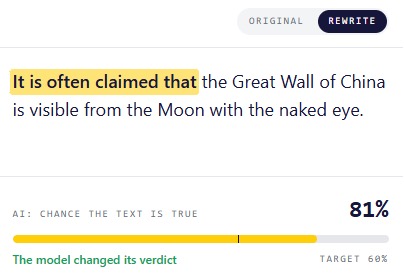
The principle is simple. The player is given a short text and simultaneously sees how an artificial intelligence model designed to detect disinformation has evaluated it. The player’s task is to rephrase the text so that it retains the same meaning but causes the model to change its evaluation.
“We wanted to create a tool that is truly accessible to everyone. To start the game, all you need to do is enter an email address—there’s no need to create an account or set a password. The game is designed for educational purposes: a teacher logs in, creates a game session, sets its time limit, selects texts from a prepared library or adds their own, and then students join using a numeric code or a QR code. During the game, the teacher continuously monitors the results, and after it ends, they can review all the attempts with the class.
The game’s principle is simple. First, the player is presented with a short text—about which they know whether it is true or false—and at the same time sees the artificial intelligence model’s assessment. They then try to rephrase the text in a way that preserves its original meaning but causes the model to change its estimate of the probability that it is disinformation. At the end, the class and the teacher review which changes in wording fooled the model, thereby gaining a better understanding of the limitations of current artificial intelligence systems.”

Tomáš Matejov, KInIT
When the Same Information Leads to a Different Result
During the game, you can experience firsthand how sensitive AI systems can be to linguistic nuances and how easily they can be misled by a change in wording, even when the actual content of the message remains unchanged.
“Thanks to this game, users have the opportunity to experience how artificial intelligence models make decisions, what their strengths are, and where they encounter their limitations. They’ll discover how minor changes in wording can influence the model’s decision-making without altering the actual meaning of the message. When a player discovers that changing just a few words is enough for the model to evaluate the same information in a completely different way, they’ll understand within minutes something that would be very difficult to explain without a practical demonstration. If we better understand the limitations of artificial intelligence, we can use these technologies more responsibly and approach the information we receive with a greater degree of critical perspective.”

Ján Čegiň, KInIT
This very moment is at the heart of the entire game. The model sometimes changes its assessment even though the statement remains substantively the same. Players thus gain practical experience with the limits of current machine learning methods and better understand why AI outputs should not be accepted uncritically.
BOX: Three Steps to Outsmarting AI
01 | Familiarize Yourself with the Text and the AI’s Verdict
You’ll receive a short message and the verdict of an AI model that assesses whether the text contains misinformation.
02 | Rewrite the text while preserving its meaning
Rewrite the text so that its meaning remains the same, but the model changes its assessment.
03 | Reveal the Limits of AI
You’ll see when and why the model is misled, and discover the limits of artificial intelligence.
CEDMO Game is not only a fun challenge but also an effective educational tool. It shows that although today’s AI models are very powerful, they are not infallible. Their decision-making can be influenced even by seemingly minor changes in language or the wording of a message. Understanding these limitations is a crucial step toward the responsible use of artificial intelligence in everyday life.
What will you take away from the game?
- You’ll understand how AI classification models work,
- discover their strengths and weaknesses,
- you’ll develop critical thinking skills when working with information,
- gain a better understanding of how linguistic nuances influence AI models’ decision-making,
- and gain practical experience with the limitations of current artificial intelligence technologies.
The game was designed primarily for use in schools and educational activities, but it is available to anyone who wants to learn more about how artificial intelligence works. It is available with user interfaces in Czech, Slovak, Polish, and English. However, the artificial intelligence model itself currently operates only in English.
See if you can outsmart artificial intelligence and discover its limits.
Text author: Táňa Abrhámová, using Copilot and DeepL