
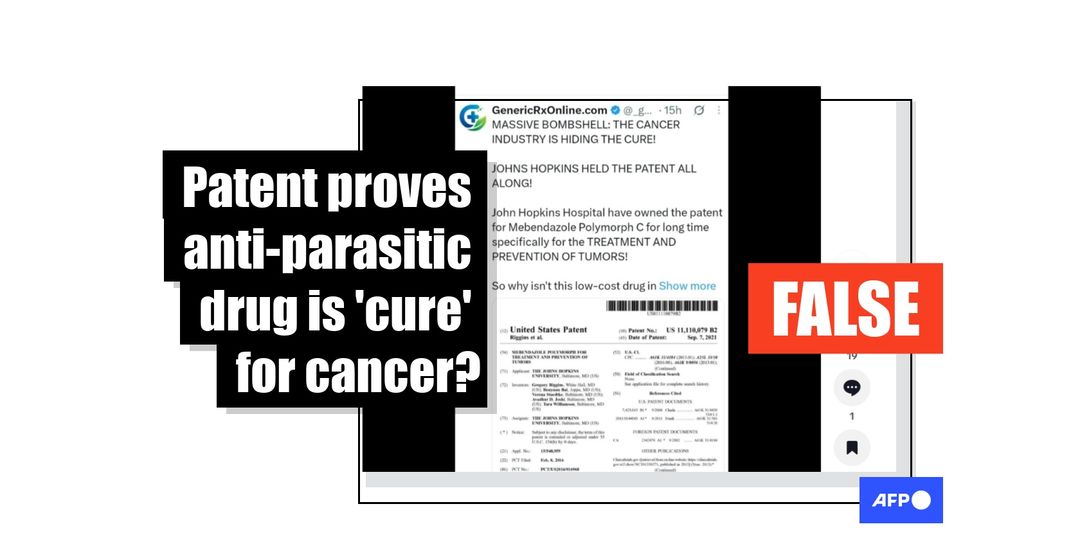
The anti-parasitic drug mebendazole has shown preclinical efficacy in targeting multiple cancers, but experts say social media posts calling it a “cure” go too far. Additional clinical trials in humans are necessary to prove when, at what dosage, and in which treatment combinations it could make an impact.
“MASSIVE BOMBSHELL: THE CANCER INDUSTRY IS HIDING THE CURE! JOHNS HOPKINS HELD THE PATENT ALL ALONG!” says an August 29, 2026 Facebook post.
The post includes a screenshot of the US patent issued in 2021 to researchers at Johns Hopkins University in the state of Maryland (archived here). The patent is titled, “Mebendazole polymorph for treatment and prevention of tumors.”
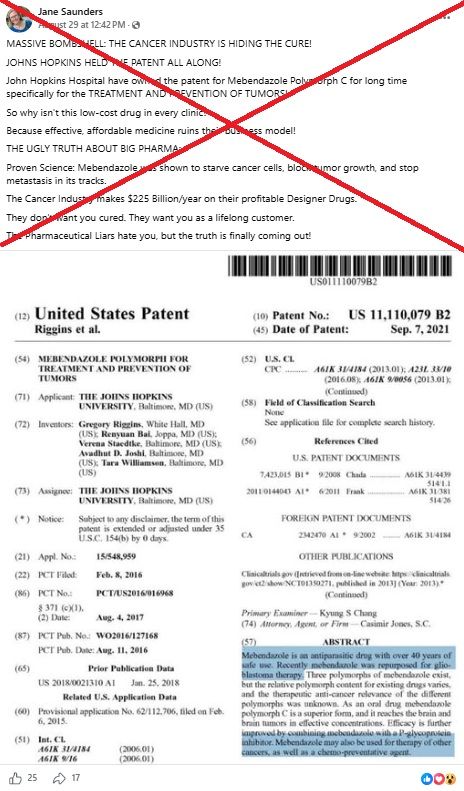
Similar posts questioning why the institution holds the patent, or alleging an effort to keep an affordable cancer treatment from patients, circulated widely across platforms.
William Makis, a Canadian physician whom AFP has repeatedly fact-checked for spreading medical misinformation, amplified the claims.
Mebendazole is an anti-parasitic medicine approved to treat worm infections (archived here). It is only available via prescription in the United States and Canada (archived here and here).
The drug is considered a strong candidate for repurposing in oncology as a possible anti-cancer therapeutic (archived here).
But Gregory Riggins, a Hopkins professor of neurosurgery and oncology who is listed as the first inventor on the patent, told AFP “the efficacy of mebendazole in oncology has not been established through the much-needed larger clinical trials” (archived here).
“It is possible it is not effective,” he said in a September 4 email.
Pointing to his research, Riggins said that what has been shown is that high doses of mebendazole “are safe in cancer patients, well – tolerated and have a reasonable chance of being effective” (archived here).
He said the drug will not be for all patients or cancers, however. The latest evidence suggests it is “best used early in therapy prior to metastasis or as a prevention against tumor recurrence, or as a prevention in individuals who have inherited a high-risk cancer-causing gene mutation,” he said.
‘Secondary patent’
The patent mentioned in the online posts is valid.
It was awarded to Riggins and a team of Hopkins researchers who invented mebendazole polymorph C, a specific molecular structure of the medicine. Johns Hopkins Technology Transfer advertised it, and Riggins said a company licensed it, but he lamented they have not yet taken it to clinical trials.
The patent’s existence, however, is not proof of a proven cancer cure.
The change Riggins and his colleagues made to the crystal structure helped mebendazole be “more effective in brain cancer models because it is absorbed better, reaches higher concentrations in the blood plasma and higher, more effective amounts in tumors, including brain cancers,” he said.
The polymorph C invention was granted what is known as a “secondary patent” according to Robin Feldman, an intellectual property expert who directs the Center for Innovation at UC Law, San Francisco (archived here).
Feldman said that while any patent can delay or deter the availability of generic drugs, secondary patents also provide market incentives that can encourage companies to undertake research and development necessary to move science forward.
Adjustments to a drug’s dosage or delivery system that demonstrate value “should be able to earn its reward in the market,” she told AFP in a September 2 email.
Take under supervision
Riggins cautioned that taking mebendazole is not without risks.
“Among the dangers is a potentially dangerous drug interaction with a certain antibiotic and monthly blood tests are needed to monitor liver function and the possibility of anemia,” he said.
Keith Stewart, University Health Network’s vice president for cancer and director of Canada’s Princess Margaret Cancer Centre, agreed (archived here).
“Self-medicating with drugs that have not been proven effective for cancer may expose patients to unnecessary risks and could delay or interfere with evidence-based care,” he warned in a September 9 email.
While cancer patients are understandably interested in all possible treatment options, including research into mebendazole, Stewart told AFP: “There is currently no accepted evidence that it provides a significant benefit in treating human cancers.”
AFP has previously fact-checked content falsely touting the anti-parasitic medicines fenbendazole and ivermectin as cancer “cures.”